

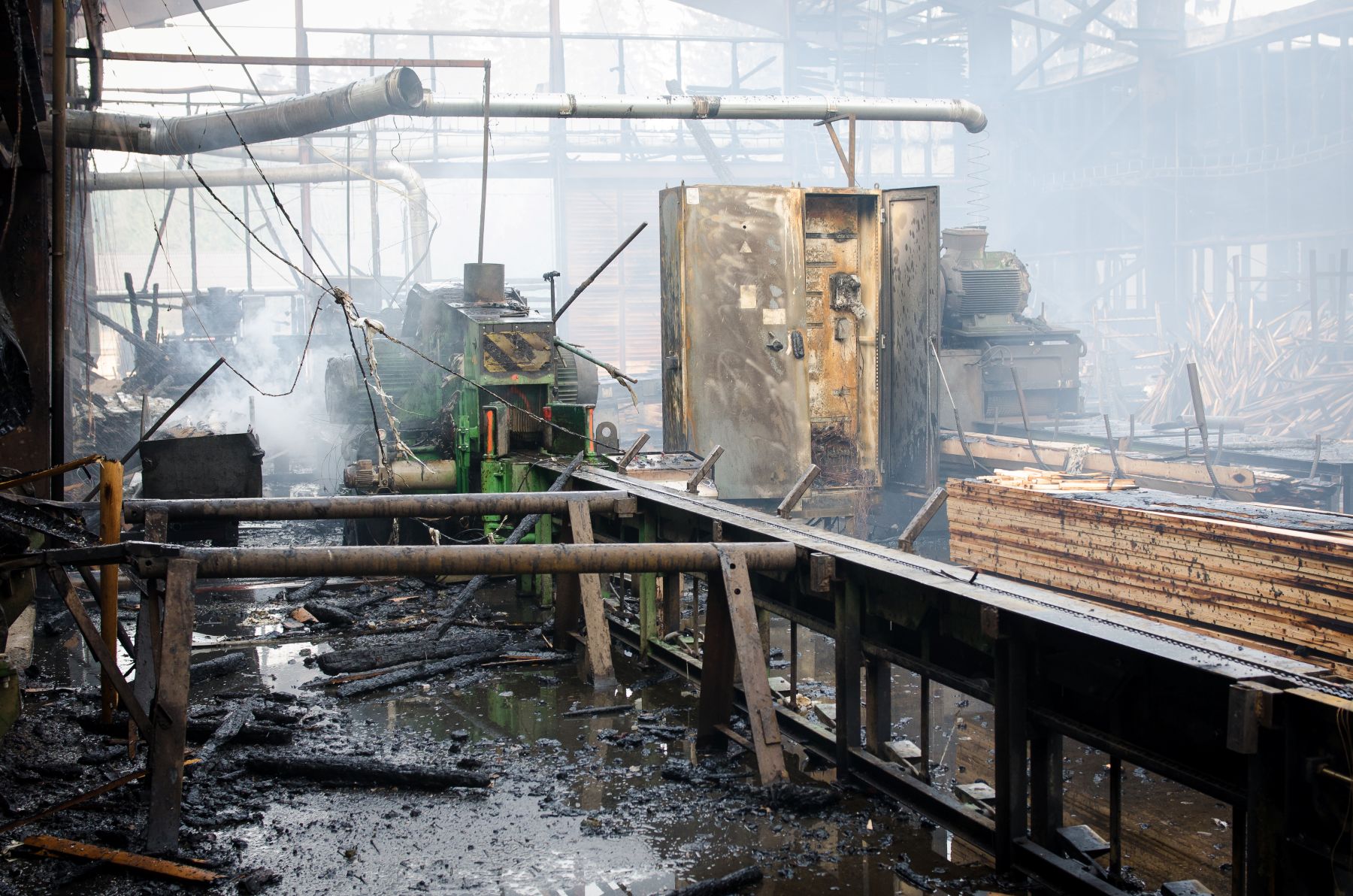


After a fire, one priority is often determining what electrical equipment can be cleaned, restored, and returned to service. Preserving complex machinery can significantly reduce the disruption and cost associated with a loss. But not every component can be restored.
Dry-type transformers, open-frame motors, circuit breakers, fuses, and other electrical components can respond very differently to smoke, soot, heat, and even the cleaning process itself. Understanding where restoration remains practical and where replacement becomes the more appropriate option is an important part of developing a sound post-loss strategy.
Why Some Electrical Components Are More Vulnerable
The challenge begins with how certain electrical components are built.
Dry-type transformers contain densely wound coils, insulating paper, varnish-coated conductors, exposed connections, and laminated magnetic cores. Because these assemblies are not hermetically sealed from their surroundings, smoke and soot can reach insulation systems and other areas that may be difficult to access, inspect, or clean. Open-frame motors present similar concerns because their internal windings are exposed to the surrounding environment. Combustion residues may be corrosive or conductive, and contamination deep inside densely wound assemblies can be difficult to evaluate and remove, which puts future reliability in doubt.
Cleaning Has Its Limits
The cleaning method and the way a component is built play an important role in the specialized decontamination following a loss.
Compressed air, for example, may remove loose surface debris but can also drive fine soot and combustion residue farther into difficult-to-reach winding and insulation areas. IEEE, manufacturer and federal maintenance guidance limits compressed air used for dry-type transformers to relatively low pressure, typically not exceeding 25 psi. Manufacturers also warn against using liquid cleaners on dry-type transformers because they can damage the winding insulation. In our judgment, liquid may soak into the windings, and those spaces can’t be reliably inspected or dried in the field.
Restoration Versus Replacement
A successful recovery strategy does not necessarily require choosing between restoring an entire machine or replacing it.
The better question is which parts can be reliably and economically restored, and which are better replaced.
For dry-type transformers, NEMA GD 2-2021 provides published guidance placing dry-type transformers and dry-type control circuit transformers in the “replace equipment” category following fire- and heat-related exposure.
In our experience, large open-frame motors can often be restored, but not on site. The correct path is a specialized motor shop that has the equipment to remove and rewind the windings and properly address the contamination. For smaller motors, rewinding often costs more than replacement.
That distinction is important because replacing a vulnerable component does not necessarily mean abandoning a larger piece of equipment that can otherwise be restored. Accessible, non-porous portions of a machine may remain viable candidates for servicing while contaminated components containing inaccessible windings or porous insulation are replaced.
Looking Beyond Transformers and Motors
The same restoration-versus-replacement analysis extends into the broader electrical distribution system.
Molded-case circuit breakers, standard low-voltage fuses, GFCIs, AFCIs, surge protective devices, receptacles, switches, and similar devices can present an economic challenge after smoke, soot, or thermal exposure. For comparatively low-cost components, the labor involved in disassembling, cleaning, evaluating, testing, documenting, and reinstalling the equipment may exceed the cost of replacing it.
Finding the Boundary of Restoration
Post-loss recovery is ultimately an exercise in making informed decisions about where restoration provides value or greater certainty and cost.
Directing specialized restoration efforts toward equipment and assemblies that can be effectively recovered, while replacing selected components that do not lend themselves to reliable or economical restoration, can help preserve larger assets while supporting a practical return to service. Those decisions should be based on the specific conditions of the loss, applicable guidance, manufacturer recommendations, testing, and qualified engineering evaluation.
Read the full paper, The Boundary of Restoration: Replacement Considerations for Dry-Type Transformers and Open-Frame Motors in a Post-Loss Environment, for a deeper examination of contamination, cleaning limitations, industry guidance, and the technical and economic considerations surrounding restoration and replacement decisions.
Amir Ruben
Service Line Principal
Ken Gentile, PE
Senior Forensic Electrical and Fire Protection Engineer